For most investors, choosing a financial advisor comes down to trust.
You sit across a conference table, hear a polished pitch, read some marketing, and hope you are making the right decision with your life savings.
There is a tool that is free, public, and shockingly underutilized that gives you a window into an advisor’s history, discipline record, licensing, and professional past.
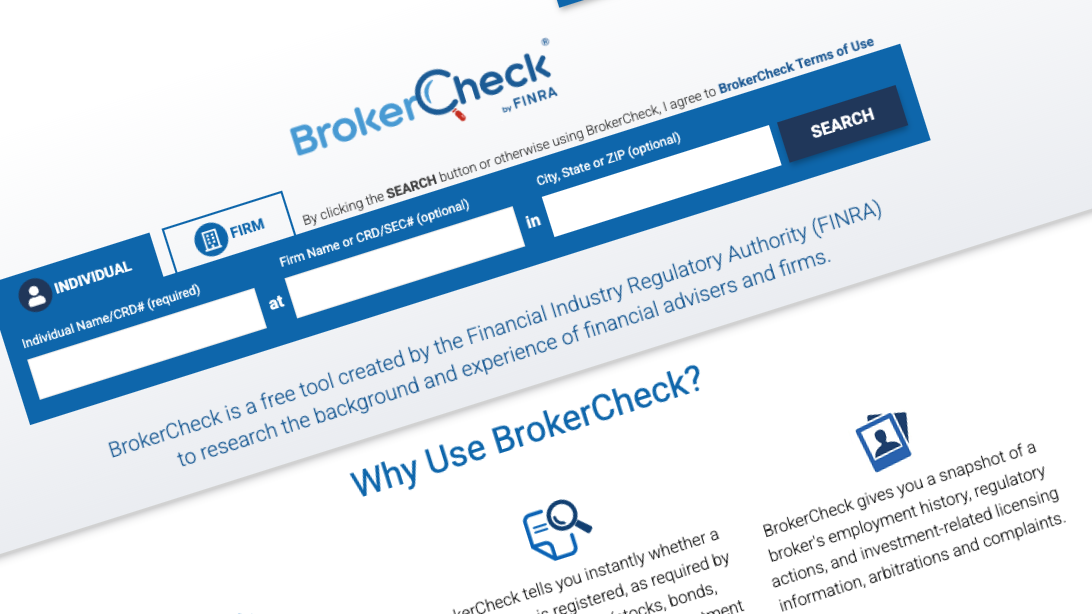
It is called BrokerCheck.
Developed by FINRA, BrokerCheck is essentially a background report on virtually all wealth practitioners. It is considered by many to be the single most objective data source investors can use before hiring someone to manage their wealth. The fact that most investors have never used it is not only alarming, it is an avoidable vulnerability.
Why BrokerCheck Exists
Financial advisors are required to disclose regulatory exams passed, where they worked, and whether they have client complaints, arbitration cases, or disciplinary issues. BrokerCheck is the public portal to view all of that information.
Think of it as due diligence. The same way you might look up reviews before buying a refrigerator or research a contractor before you hire them. Except here, the stakes are exponentially higher.
What You Can Learn in One Search
By typing in an advisor’s name or firm, investors can instantly see:
- Professional history, which firms they have worked for and for how long
- Licensing exams, for example the Series 7, Series 66, and other credentials
- Registration status, whether they are a broker, an investment adviser, or both
- Disclosure events, complaints, customer disputes, disciplinary actions, terminations, or financial compromise events
This is not opinion, marketing, or spin. It is a regulatory record that tells a story. Did an advisor move firms every year? Have they faced multiple customer arbitration claims? Or does their file show decades of clean service? These insights should shape the confidence you place in them.
How to Use BrokerCheck Step by Step
- Go to brokercheck.finra.org
You do not need a login. It is open to the public. - Enter an advisor’s name or firm
The system will auto populate likely matches. - Click into the advisor profile
You will see employment history, licenses, disclosures, and exam details. - Review the “Disclosures” section carefully
This is where you find complaints, settlements, or disciplinary records.
Not all disclosures are equal, and some may be minor. However, patterns matter. - Look at the timeline
Do they have a stable background or frequent job shifts? - Use it as a conversation tool
If you see something, ask the advisor to explain it.
Why Investors Do Not Use It and Why That Needs to Change
Many investors assume that if someone works at a big firm, they must be vetted.
Unfortunately, that assumption has cost families millions. Others do not know BrokerCheck exists or believe it is a tool reserved for professionals. The truth is simple – the industry is intimately familiar with BrokerCheck. We believe investors should too.
How to Read Red Flags
A single complaint from many years ago may not be meaningful. Context matters. But multiple similar complaints, sudden terminations should prompt deeper conversation. You are not judging. You are verifying. Every legitimate advisor should welcome that. The advisors who resist transparency often do so for a reason.
What Good Advisors Want You to Know
The best advisors encourage prospective clients to check BrokerCheck.
They know reputations are earned over time, and a clean record reinforces trust.
This is also one area where independence has become a major force. Many advisors leaving large firms use BrokerCheck to highlight their clean history before launching their own practices.
Your Money Deserves Verification
Selecting an advisor is one of the most impactful financial decisions you will ever make. You would not hire a contractor without references or expect a pilot to fly without credentials. Why should wealth management be any different?
Before you sign paperwork, transfer assets, or hand over your life savings, take sixty seconds and verify who you are trusting. Ask questions. Read disclosures. Make informed decisions. BrokerCheck does not replace relationships. It simply gives investors something the industry rarely gives voluntarily – clarity. And clarity is the foundation of confidence.