
This summer, we saw inflation hit 3.4%1 year over year, while core inflation cooled to 2.4% – a level not seen since March 2021 – though still above the Federal Reserve’s target. That’s a far cry from the near-9% spike of 2022. And while it’s tempting to read “cooling” as “solved” … it isn’t. Inflation doesn’t have to stay elevated to keep doing damage.
Inflation Resets the Baseline
This is the part that trips people up. The vocabulary matters:
- Inflation means prices are rising and the price level goes up.
- Disinflation means the rate of increase is slowing and prices are still rising, just more gently. The price level keeps climbing.
- Deflation means prices are actually falling and the price level goes down.
“Inflation is coming down” sounds reassuring, and in one sense it is. But it does nothing to undo the price increases that already happened. If the cost of living jumps 9% in a year, as it did in 2022, and then cools to a slow crawl afterward, that increase is still built in. The only way it unwinds is through deflation, or actual price declines, which the Fed works hard to avoid because falling prices create serious economic risks. In practice, once prices move up, they rarely come back down.
As a consumer, that means a bad inflation year doesn’t need to repeat itself to keep hurting you. It already did its damage the moment it happened, and you keep paying that higher baseline indefinitely. That sudden increase in overall prices often hits retirees the hardest.
Why Retirees Feel it the Hardest
A worker’s wages tend to catch up to inflation over time. It may happen unevenly, but they catch up. On the other hand, a retiree living off a fixed pool of assets doesn’t automatically get that adjustment. If every year prices rise 3% instead of 2%, the same withdrawal buys a little less, and that gap compounds over a 20-, 30-, even 40-year retirement.
But the average rate over that period isn’t actually the number that determines how much damage is done – it’s the sequence. Two retirements can experience the same average inflation and cost of living yet end up in very different outcomes by year ten. That’s because retirees don’t feel inflation only at the end of a decade or retirement; they pay for it along the way, making withdrawals in real dollars versus specific points in time.
Run the numbers on a simple example: a retiree spending $1,000 a month, adjusted annually for cost of living. In one scenario, inflation spikes in years one and two, then cools. In another, it stays low for eight years before the same spike hits in years nine and ten. Both paths produce identical total inflation over the decade and land on the exact same cost of living by year ten. But the retiree who hit the spike early spends roughly $157,600 in total over the ten years, versus roughly $144,200 for the retiree who hit it late – a difference of nearly $13,500, driven entirely by when the inflation hit, not how much.
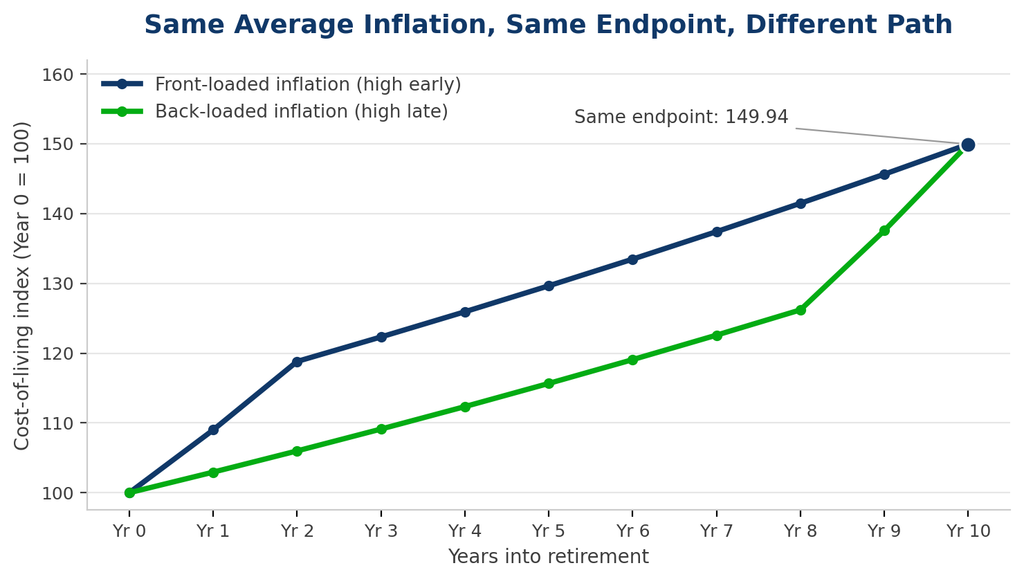
That gap is why timing matters: early inflation forces larger withdrawals when the portfolio has had the least time to grow, permanently reducing the capital available for the years that follows.
Protecting a Portfolio Against Inflation
“Protect against inflation” usually gets treated as one goal, when it’s really two. Conflating them is where a lot of inflation strategies go wrong.
Hedging is designed to move with inflation, cushioning the surprise over a specific, usually shorter window. Typically, at the cost of long-run growth potential.
- Floating-rate instruments and short-duration fixed income: don’t hedge inflation directly, but can limit how much a rate spike hurts the underlying holding.
- Commodities and gold: have shown some positive correlation to inflation shocks, particularly energy-driven ones, However, the relationship is inconsistent and neither generates income.
Outperformance isn’t trying to track inflation month to month. Rather, it’s about trying to compound a real return (return above inflation) over a horizon long enough that short-term inflation noise washes out.
- TIPS (Treasury Inflation-Protected Securities): The principal adjusts with CPI, and the bond pays a real yield on top. TIPS held to maturity are designed to deliver inflation plus the real yield set at purchase, which has at times been negative. That real yield has varied over time, and TIPS can still lose nominal value if real rates rise, but the design intent is outpacing inflation, not just matching it.
- Equities: Over long periods, have historically delivered outsized returns, which is why they tend to do most of the heavy lifting in a portfolio. From 1928 through the end of 2025, the S&P 500 compounded at 9.9% per year including dividends reinvested, versus 3.1% per year for CPI over that same 98-year span (see chart below). The trade-off is volatility. Stocks can lag or fall in the same year inflation spikes, which may be manageable on a 20-year horizon but painful if you need to withdraw from that bucket right now.
- Real estate / REITs: Rents and property values have tended to adjust upward with inflation over time, but remain market-priced assets that can be volatile in the short run.
Here’s how $100 invested in the S&P 500 in 1928 would have grown with dividends reinvested, compared with the rise in the cost of living over the same period:
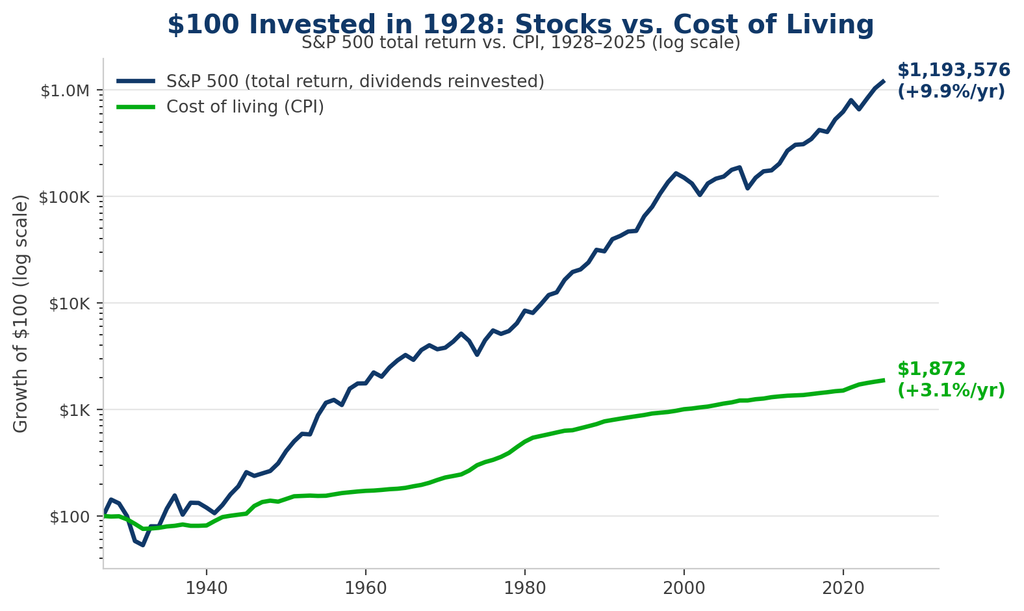
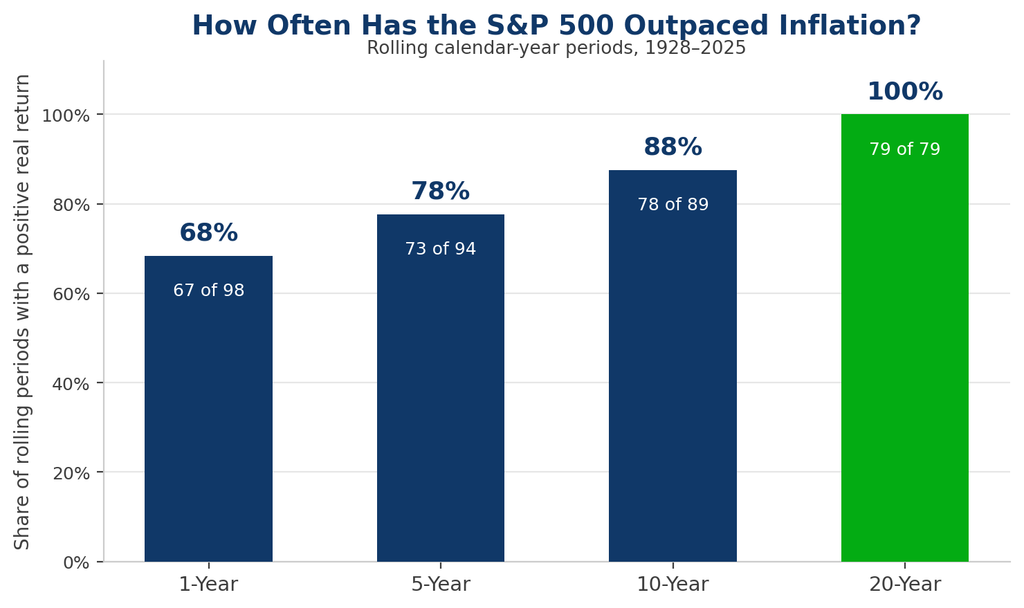
Over long periods of time, stocks have a strong record of outpacing inflation, but over shorter periods the outcome is far less certain. That’s why investors need portfolios that address both the short-term and long-term challenge. Money needed in the next one to five years is better served by hedge-like, lower-volatility instruments, because there isn’t time to ride out a bad stretch. Money with a longer horizon can lean on the growth engine, because longer holding periods have historically narrowed the odds of falling behind inflation.
What this Actually Means for a Plan
This is not a call to overhaul anything based on one CPI print nor is it a forecast. It’s a case for treating inflation risk with the same rigor we apply to market risk in a retirement plan by stress-testing for it, not averaging it away:
- Revisit your withdrawal rate in real terms, not just nominal terms. A rate designed to hold up in a 2% inflation world may need a second look in a 3%-plus world.
- Stress-test the plan by modeling higher starting costs, just as a strong plan already tests for a market downturn in year one.
- Make sure your fixed income is doing inflation-aware work. TIPS and duration management can help cushion purchasing-power risk, even if they can’t eliminate it.
- Include equities as part of a diversified portfolio. Their long-run record of outpacing inflation is why they typically do the heavy lifting for money with a longer horizon.
- Don’t mistake “safe” for “guaranteed to maintain purchasing power.” Cash feels safe day to day, but a portfolio sitting entirely in cash still takes on inflation risk while avoiding market risk. A diversified mix, not any single asset, is what’s built to address both the short-term and long-term challenge at once.
Inflation is not a headline that simply resolves itself or fades with the news cycle. It’s a lasting adjustment to your cost of living that arrives on its own schedule. The retirement plans that hold up best are the ones built to withstand inflation arriving at the worst possible time.
1Sources: U.S. Bureau of Labor Statistics (CPI data as of August 2026, the most recent report available at publication); J.P. Morgan Asset Management, Guide to the Markets – U.S.; Standard & Poor’s; FactSet; S&P 500 total return and CPI inflation data, 1928–2025, compiled from Robert Shiller (Yale University) and Aswath Damodaran (NYU Stern) historical return datasets. Rolling-period analysis is Quotient Wealth Partners’ own calculation using annual real S&P 500 total returns from the same dataset.
This article is for informational and educational purposes only and does not constitute investment, tax, or legal advice, or a recommendation to buy or sell any security. Past performance is not indicative of, and does not guarantee, future results. Index performance (e.g., the S&P 500) is shown for illustrative purposes only; indices are unmanaged, incur no fees or expenses, and are not available for direct investment. All investing involves risk, including the possible loss of principal. Statements regarding future events are forward-looking, subject to change without notice, and are not guaranteed. The hypothetical inflation and spending examples above are for illustrative purposes only and do not represent any actual investment or account. Quotient Wealth Partners, LLC is an SEC-registered investment adviser. Registration does not imply a certain level of skill or training. This material has not been reviewed by any regulatory authority.